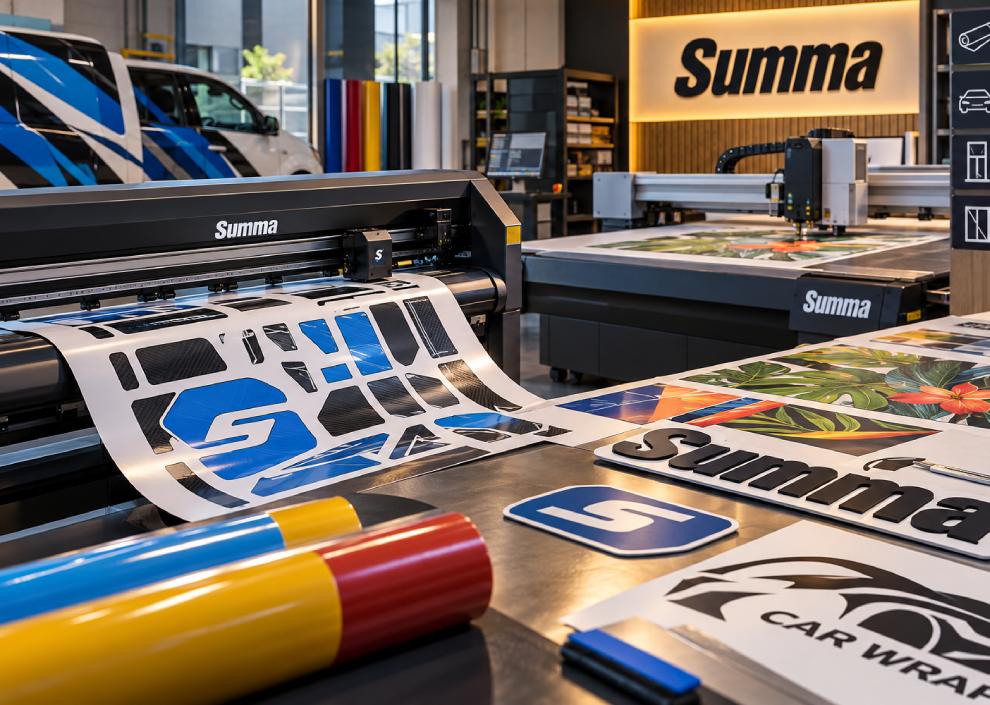
If your signage business is still fighting with misaligned cuts, jagged edges on printed graphics, or a cutter that cannot keep up with your printer, the bottleneck usually is not your design work. It is your cutting equipment.
Summa has built its reputation on solving exactly this problem. As a European engineered cutting brand used by sign makers, printers and packaging businesses worldwide, Summa’s roll and flatbed cutters are designed around one idea: the cut should be as accurate as the print. Here is what that looks like in practice, and how to figure out which Summa system fits your production.
What Makes Summa Cutting Different
Most entry-level vinyl cutters rely on a drag knife dragged across the material at a fixed angle. That works fine for simple shapes, but it struggles with tight curves, small text, and intricate contours, where the blade tears the material instead of slicing cleanly.
Summa’s higher-end machines use tangential cutting instead. The blade rotates to follow the exact direction of the cut line in real time, so corners stay sharp and fine detail holds up even at speed. This is the difference you notice on jobs like small lettering, holographic vinyl, or heat transfer vinyl for apparel, where a drag knife cutter would round off the edges.
Summa also builds in OPOS, its camera based optical registration system. Once a printed sheet or roll is loaded, the camera reads registration marks and automatically aligns the cut path to the print, correcting for any stretch, skew or bow in the material. For print and cut work, this is what keeps contour cuts sitting exactly on the printed edge, job after job, without an operator manually nudging alignment on screen.
Roll Cutters vs Flatbed Cutters
Summa’s range splits into two main categories, and picking the right one comes down to what you are cutting and how much of it.
Roll cutters (S One and S3 Series) handle vinyl, labels, films and printed graphics fed from a roll. These are the workhorses for continuous sign and display production: vehicle wraps, window graphics, floor and wall graphics, and point-of-sale displays. The S3 Series adds tangential cutting for applications where material thickness or fine detail rules out a drag knife, while the S One Series covers everyday decals and signage at a more accessible entry point. Summa’s FlexCut feature is also worth knowing about here. It creates a perforated cut that keeps the material stable enough to feed through the cutter, while still letting individual pieces snap apart cleanly once the job is done.
Flatbed cutters (F Series and Optima) are built for rigid or semi-rigid materials that cannot be rolled, along with high volume packaging and signage work. These use a vacuum bed to hold the material flat while a cutting head with interchangeable tools handles cutting, creasing and kiss cutting on the same run. If your shop is moving into rigid substrate signage, POS packaging, or display boards alongside your roll based work, this is the category to look at.
Applications Where Precision Cutting Pays Off
Some jobs simply do not work without tangential cutting and accurate registration:
- Vehicle wraps and fleet graphics, where intricate curves around door handles and panel lines need to be razor sharp
- Window graphics and clings, where fine detail is often the whole point of the design
- Heat transfer vinyl for apparel, where delicate materials tear easily under a standard drag knife
- POS and retail displays, where contour cutting has to track printed artwork precisely, shape after shape
- Reflective and heavy duty signage, where the material itself is harder to control and cut cleanly
In each of these cases, the cost of a poor cut is not just wasted material. It is a job that has to be reprinted, recut and redelivered, which eats into both margin and turnaround time.
Choosing the Right Summa Cutter for Your Shop
A few questions help narrow down the decision:
- What are you cutting most often? Roll based vinyl and films point you toward the S One or S3 Series. Rigid substrates, packaging, or a mix of materials point toward the F Series or Optima flatbed range.
- How much of it are you cutting? Lower volume, simpler shapes can run comfortably on an entry level drag knife system. High volume, detailed contour work justifies the move to tangential cutting.
- Is print and cut alignment critical to your jobs? If you are cutting around printed graphics rather than plain material, OPOS camera registration is not optional. It is what keeps your finished pieces looking professional.
- Do you need to scale later? Summa’s modular tooling on the flatbed range means you can add capabilities as your job mix changes, rather than replacing the whole machine.
Summa’s cutting systems are also built to work with any RIP software and integrate into existing production lines, so adding one does not mean overhauling your current workflow.
Talk to USC Solutions
USC Solutions supplies and supports the full Summa cutting range across Singapore and Malaysia, from entry level roll cutters to industrial flatbed systems. If you are weighing which model fits your material mix and volume, our team can walk you through a live demo and match the right Summa cutter to your production line.