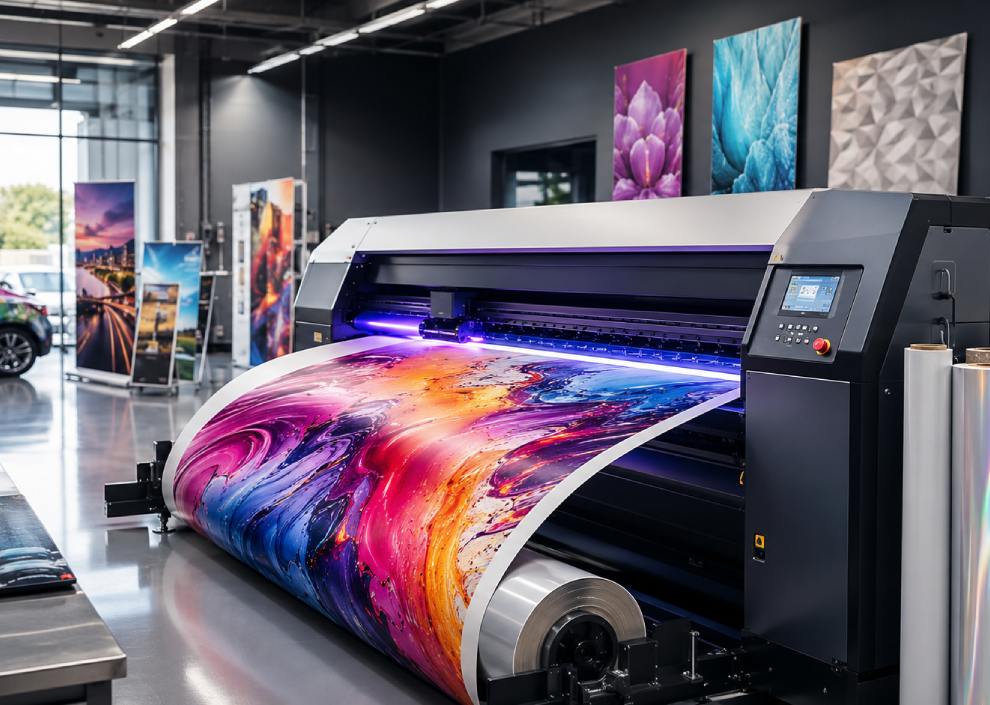
If your print shop is weighing a move into UV technology, you have probably run into two options: UV flatbed and UV roll-to-roll. They sound similar, but they solve different production problems. UV roll-to-roll printers combine the instant-cure advantage of UV ink with the speed and flexibility of roll-fed media, making them one of the most versatile machines a wide format shop can add to its floor.
This guide covers how UV roll-to-roll printing actually works, where it fits best, what it costs to run, and the questions worth asking before you buy one.
What Is UV Roll-to-Roll Printing?
A UV roll-to-roll printer feeds flexible media, such as vinyl, banner material, wallpaper, or window film, from a roll, prints on it using UV-curable ink, and cures the ink instantly with LED lamps built into the print carriage. Unlike eco-solvent printing, where the print needs hours to off-gas before it can be laminated or cut, UV ink sets the moment light hits it. The print comes off the machine ready to finish.
It sits between two familiar categories. Like eco-solvent printers, it runs continuous roll media and suits high-volume signage work. Like UV flatbed printers, it uses UV-curable ink that cures on contact and handles a wider range of substrates than solvent ink alone. UV roll-to-roll takes the best of both: roll-fed speed with UV durability and versatility.
How UV Roll-to-Roll Printers Work
The process is straightforward in principle, even though the engineering behind it is precise:
- Media feed: Roll media is loaded and fed through the printer under tension, similar to a solvent or latex printer.
- Ink deposition: Printheads jet UV-curable ink onto the surface. Because UV ink sits on top of the media rather than soaking in, it works across a wider range of coated and uncoated stocks.
- Instant curing: LED UV lamps mounted beside or behind the printhead cure the ink almost immediately as it is laid down, locking in colour and sharpness without waiting for solvent to evaporate.
- Rewind or cut: The finished print can be rewound onto a take-up roll or cut and moved straight to lamination, application, or shipping.
Because there is no drying or off-gassing stage, turnaround time drops significantly compared to eco-solvent workflows, particularly on rush jobs.
Applications: Where UV Roll-to-Roll Printing Excels
UV roll-to-roll printers are used across a wide range of commercial and industrial print work, including:
- Backlit displays and light boxes: UV ink’s density and the ability to print white ink layers make it well suited to backlit graphics that need even light diffusion.
- Vehicle wraps and window graphics: Sharp colour, fine detail, and durability without a lamination step for some applications.
- Wallpaper and interior décor printing: UV ink’s low-odour, low-VOC cure makes roll-to-roll a practical choice for wall coverings and interior signage printed close to occupied spaces.
- Point-of-sale and retail graphics: Fast turnaround supports short-run, frequently updated campaign material.
- Specialty and textured media: Some UV roll-to-roll systems support varnish or texture layers for embossed effects on flexible substrates.
Key Benefits of UV Roll-to-Roll Printing
Instant Production Turnaround
Since UV ink cures on contact, prints can be laminated, cut, or shipped right away. There is no 24- to 48-hour waiting period that eco-solvent workflows require, which matters for shops running tight deadlines.
Broader Media Compatibility
UV ink sits on top of the media rather than absorbing into it, so UV roll-to-roll printers can handle a wider variety of coated, uncoated, and specialty roll substrates than eco-solvent alone.
Lower VOC Output
UV curing is a photochemical reaction rather than an evaporative one, so it releases far fewer volatile organic compounds during production. This makes UV roll-to-roll printers more practical for workspaces without heavy-duty ventilation.
Consistent Colour and Sharpness
Because the ink cures instantly instead of spreading or dot-gaining as it dries, UV roll-to-roll output tends to hold fine detail and colour consistency well across long runs.
Reduced Finishing Costs on Some Applications
For jobs that would otherwise need overlamination for protection, UV’s inherent durability can reduce or eliminate that finishing step, depending on the end use and expected outdoor exposure.
What to Consider Before Buying a UV Roll-to-Roll Printer
A UV roll-to-roll system is a bigger investment than a standard eco-solvent printer, so it is worth evaluating carefully against your actual production mix.
- Upfront and ink cost: UV printers and UV ink typically cost more than eco-solvent equivalents. Weigh this against the finishing time and lamination costs you will save.
- Media flexibility needs: If your work is mostly flexible vinyl, banners, and wraps that don’t require rigid substrate printing, confirm the roll-to-roll model fits your workflow rather than a hybrid or flatbed system.
- Ink flexibility for wraps and stretch applications: Some UV inks are more rigid than eco-solvent ink, which can matter for vehicle wrap installers working over contours and rivets. Ask about flexible UV ink formulations if this applies to your work.
- White ink and multi-layer capability: If backlit or window graphics are part of your business, confirm the printer supports white ink channels and layering.
- LED lamp life and maintenance: LED UV curing systems are generally lower-maintenance than mercury-vapour UV lamps, but it is still worth understanding replacement costs and service intervals.
- Local support and parts availability: Downtime on a UV system can be costly. Choose a supplier with local stock, service engineers, and fast parts turnaround in Singapore or Malaysia.
UV Roll-to-Roll vs Eco-Solvent vs UV Flatbed: A Quick Comparison
| Factor | Eco-Solvent | UV Roll-to-Roll | UV Flatbed |
| Media type | Flexible only | Flexible, roll-fed | Rigid and flexible |
| Cure time | 24 to 48 hours off-gassing | Instant | Instant |
| Typical use case | High-volume banners, wraps | Backlit, wallpaper, wraps, POS | Rigid signage, custom objects |
| VOC output | Moderate | Very low | Very low |
| Upfront cost | Lower | Higher | Higher |
UV Roll-to-Roll Printers We Supply
USC Solutions supplies UV roll-to-roll systems built for continuous production, accurate ink placement, and dependable media handling. Here’s a model from our current UV roll-to-roll printer range:
- MUTOH XpertJet 1682UR — A dual-head, 64-inch UV roll-to-roll printer built for signage, vehicle wraps, and fine art graphics. It uses dual-drop technology for high colour accuracy and supports up to 5-layer roll-to-roll printing, making it a strong fit for backlit, décor, and specialty applications that need white ink or varnish layering.
For a full rundown of specifications, supported media, and pricing, visit the XpertJet 1682UR product page or browse our complete UV roll-to-roll printer lineup.
Is UV Roll-to-Roll Right for Your Print Shop?
UV roll-to-roll printing makes the most sense for shops that print high volumes of flexible media and need fast turnaround without sacrificing durability or media range. If most of your work is short-run flexible signage on a tight deadline, or you are handling backlit and interior décor jobs that benefit from low-VOC printing, it is worth a serious look. Shops that print heavily on rigid substrates, or whose volumes don’t justify the higher equipment cost, may still be better served by eco-solvent or UV flatbed systems.
USC Solutions works with businesses across Singapore and Malaysia to match production needs with the right wide format hardware, whether that’s UV roll-to-roll, eco-solvent, or UV flatbed. Get in touch with our team to discuss your production volumes and application needs, and we’ll help you find the right fit.