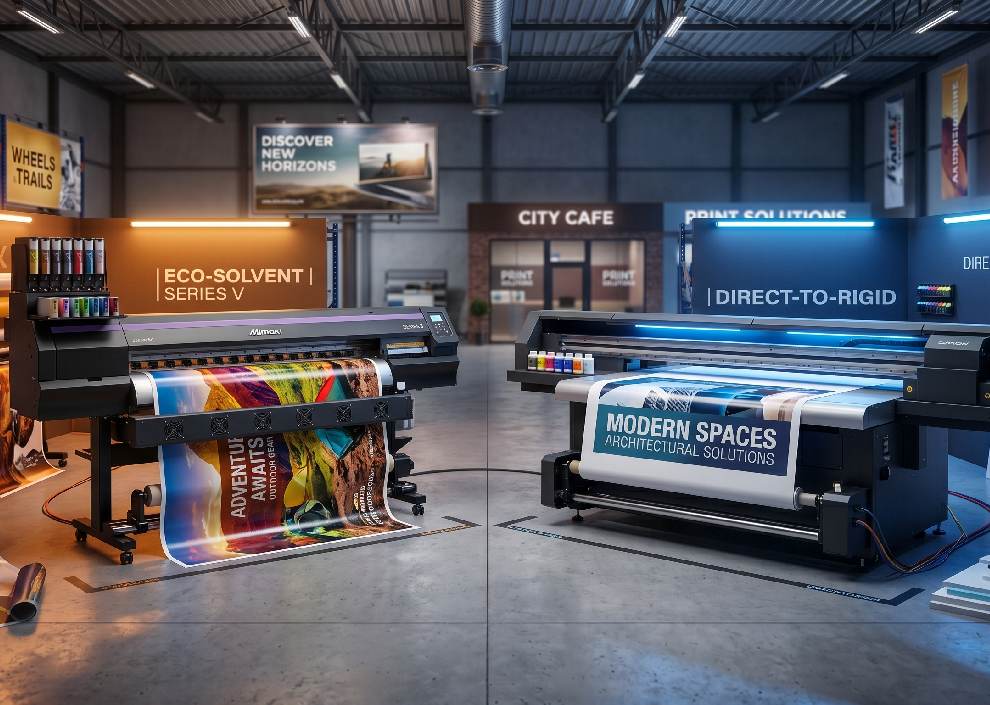
If you run a signage business, print shop, or advertising agency in Southeast Asia, you’ve likely faced this question: Should I invest in an eco-solvent printer or a UV printer?
Both technologies are capable of producing stunning large-format output. Both are used for outdoor applications. But they work very differently – and for outdoor signage specifically, the differences can mean a significant gap in durability, cost, and overall results.
This guide breaks down each technology in plain terms, compares them side by side, and tells you exactly which one is better for outdoor work, and when.
What Is Eco-Solvent Printing?
Eco-solvent printing uses mild solvent-based inks that partially penetrate the surface of the media during printing. As the ink dries – assisted by heaters in the printer – the solvent evaporates, leaving the pigment bonded into the substrate.
The “eco” in eco-solvent refers to the fact that these inks contain significantly lower levels of volatile organic compounds (VOCs) compared to traditional aggressive solvent inks. They’re safer to work with indoors, require less ventilation, and are gentler on printheads.
Common eco-solvent applications:
- Vinyl banners and flex banners
- Vehicle wraps and decals
- Window graphics and perforated film
- Stickers and labels
- Exhibition and trade show displays
Eco-solvent inks are available in standard CMYK configurations, with many printers also supporting light cyan, light magenta, orange, and white for extended colour gamut and special effects.
What Is UV Printing?
UV printing uses ultraviolet light to instantly cure (harden) the ink the moment it lands on the substrate. Instead of evaporating like solvent inks, UV ink is exposed to UV LED lamps that trigger a photochemical reaction – locking the ink onto the surface as a rigid, durable layer.
Because UV ink cures on the surface rather than absorbing into the material, it can print on almost any substrate – including rigid, non-porous materials that eco-solvent inks simply cannot adhere to.
Common UV applications:
- Rigid signage boards (acrylic, aluminium, PVC foam)
- Glass, ceramic, and tile printing
- Metal panels and nameplates
- Custom objects and promotional items
- Backlit displays and exhibition panels
UV printers are also capable of printing white ink and varnish layers, enabling textured, embossed, and 3D effects that are impossible with eco-solvent technology.
Head-to-Head: Eco-Solvent vs UV for Outdoor Signage
1. Weather Resistance and Outdoor Durability
This is the most critical factor for outdoor signage – and it’s where the two technologies diverge most clearly.
UV printing wins on raw durability. Once UV ink is cured, it forms a hard, glass-like coating on the substrate. This coat is highly resistant to UV radiation, rain, humidity, salt air, and surface abrasion. UV prints used outdoors on rigid substrates can last 5 to 7 years without additional protection, making them the go-to for permanent outdoor signage, building fascias, and directional signs.
Eco-solvent inks also hold up well outdoors – but they require extra protection. Without lamination, eco-solvent prints are vulnerable to prolonged UV exposure and moisture. Industry-standard practice is to apply a protective overlaminate film, which extends outdoor life to 3 to 5 years, depending on the environment. Once laminated, eco-solvent prints are highly competitive for most outdoor signage applications.
Bottom line: UV prints are inherently more weather-resistant. Eco-solvent prints are durable but need lamination for long-term outdoor use.
2. Media Compatibility and Flexibility
Eco-solvent printing is designed for flexible media. Vinyl, self-adhesive PP, canvas, and banner cloth — these are eco-solvent’s natural territory. The ink partially absorbs into the substrate, allowing the print to flex, stretch, and conform to curved surfaces without cracking. This is why vehicle wrappers overwhelmingly prefer eco-solvent – the wrapped vinyl needs to flex around bodywork and door curves without the print splitting.
UV printing sits on top of the substrate rather than absorbing into it. On flexible media, this can cause the ink layer to crack when the material is bent or stretched. UV is therefore best suited to rigid and semi-rigid substrates. If you’re printing on acrylic signs, dibond panels, wooden boards, glass, or metal plates, UV is the only sensible choice.
Bottom line: Choose eco-solvent for flexible outdoor media (banners, vehicle wraps, window film). Choose UV for rigid outdoor signage (boards, panels, plaques).
3. Print Quality and Colour Vibrancy
Both technologies are capable of producing excellent, vibrant colour output. However, there are subtle differences worth understanding.
Eco-solvent printing is renowned for fine detail and colour depth. Because the ink penetrates the media, it takes on the finish properties of the substrate – a matte media gives matte output, a gloss media gives gloss output. For photo-quality prints, exhibition graphics, and artwork reproductions, eco-solvent’s ability to match media finishes gives it a natural edge.
UV printing tends to deliver a slightly more consistent and punchy colour appearance because the cured layer sits uniformly on the surface. UV also offers unique capabilities like clear varnish topcoats and white ink underlayers, which can produce striking visual effects not achievable with eco-solvent — including opaque white on clear film and embossed-look textures.
Bottom line: Both deliver excellent quality. Eco-solvent excels at photorealistic, close-viewing print jobs. UV offers more creative effects and a consistent surface finish.
4. Production Speed and Workflow
UV printing has a decisive advantage in production speed. UV ink cures instantly under the UV LED lamps as the printhead passes – so the output comes out dry and ready to handle, cut, and install almost immediately. There’s no waiting time between printing and finishing.
Eco-solvent printing requires a drying and outgassing period. After printing, the solvent must fully evaporate from the ink – a process that typically takes 24 hours before the print can be laminated or installed safely. In high-volume production environments, this can create a bottleneck in the workflow.
Bottom line: UV printing offers significantly faster turnaround, which matters in deadline-driven signage production.
5. Substrate Cost and Running Costs
Eco-solvent printers and media are generally more affordable than UV systems. The hardware entry point is lower, ink costs are competitive, and the wide range of compatible flexible media tends to be cheaper per square metre than rigid UV substrates. This makes eco-solvent the dominant choice for high-volume, price-sensitive work like banners, event signage, and short-term campaigns.
UV printers carry a higher upfront cost, and UV inks are typically more expensive per litre than eco-solvent inks. However, UV prints often eliminate the cost of lamination (since they resist weather without it on rigid substrates), which partially offsets the ink cost for outdoor rigid signage work.
Bottom line: Eco-solvent has lower entry costs and lower media costs for flexible output. UV has a higher initial investment but lower finishing costs for rigid outdoor applications.
6. Environmental Considerations
Both technologies have improved significantly in terms of environmental impact compared to older solvent systems.
Eco-solvent inks contain very low VOC levels, making them safe for semi-enclosed environments without heavy-duty ventilation. However, the solvent component still evaporates during the drying process, releasing small quantities of VOCs into the workspace.
UV printing produces no VOCs during the curing process, as the photochemical reaction locks all components in the ink. UV LED systems also consume significantly less energy than traditional UV mercury lamps, making modern UV printers among the more energy-efficient options in wide-format production.
Bottom line: Both are environmentally responsible choices. UV printing has a slight edge with zero VOC emissions during production and lower energy consumption.
So, Which Is Better for Outdoor Signage?
The honest answer: it depends on what type of outdoor signage you produce.
Choose eco-solvent if:
- Your outdoor work involves flexible media – vinyl banners, flex displays, vehicle wraps, window film, and fabric signage.
- You need a cost-effective solution for high-volume, short-to-medium-term outdoor campaigns.
- You’re producing work that requires close-up photo quality.
- Your budget is constrained on hardware.
Choose UV if:
- You produce rigid outdoor signage – acrylic, aluminium composite, PVC boards, metal plaques.
- You need maximum durability with no lamination step.
- Fast turnaround is critical to your business.
- You want to offer specialty finishes like varnish, texture, white ink, or direct object printing.
For many growing print and signage businesses, the ideal answer is both. A wide-format eco-solvent printer handles your flexible and soft media work, while a UV flatbed handles your rigid board and direct-object printing. Together, they cover virtually every outdoor and indoor signage brief a customer can bring you.
Choosing the Right Machine for Your Business
If you’re evaluating hardware for outdoor signage production, it’s worth speaking with a specialist who can match your output requirements to the right technology and media combination.
At USC Solutions, we supply both eco-solvent wide-format printers and UV flatbed systems from leading global brands, and our technical team can help you build the right print workflow for your application mix and budget.